
Robert Weston and Building a Classroom Around Students
Spotlight: 2025 Exceptional Faculty Award recipient
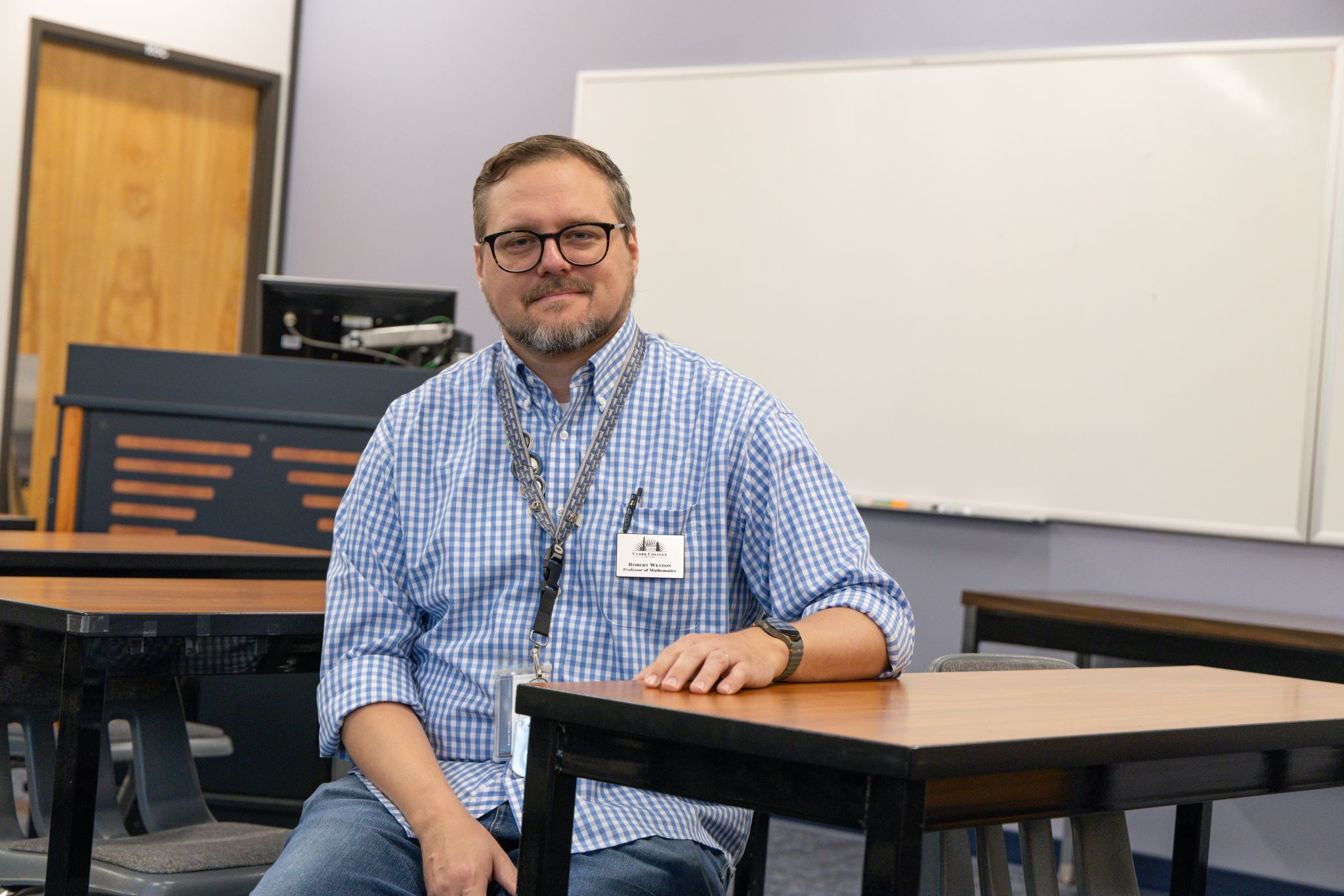
Anyone who has walked through Bauer Hall and seen a student grab a snack from the basket in the lobby has witnessed Robert Weston’s teaching philosophy in action.
A professor in Clark’s math department, Robert focuses on student-centered teaching. He doesn’t just develop their math skills; he supports the conditions students need to learn. Sometimes, that starts with food — hungry students don’t learn well, he points out.
“He has an extensive understanding of the concept that not everyone learns the same way, and he is more than willing to adjust in order to guide his students and guarantee success,” one nominator said.
That flexibility shows up in many ways. Sometimes this means adjusting his schedule so that students who can’t make it to his office hours are given the same opportunities as others. Other times, this means adjusting the class setting or using student input when planning assignments. In addition to snacks, he also keeps extra supplies on hand for students who forget their own.
“Robert has been a strong advocate for accessibility, mindful of the challenges faced by all students, and eager to make sure every student has a chance to succeed,” another nominator said.
The foundation for that success goes beyond mathematics. Classroom discussions often include time management and planning for the future. He recognizes that students have a lot on their plates, and even though it’s common to want to do it all, sometimes the best thing is to take something off the plate. He helps his students think about what they can do right now that will be most valuable to their future selves.
“My grandfather used to say, ‘What you do today is for tomorrow.’ It’s that idea of sowing your seeds and watching your efforts grow,” Robert said.
A core element you’ll see in Robert’s classroom is that he’s not the one doing most of the talking — students are. He said, “Letting students work on problems without me telling them how will empower them to take risks.”
His classes are interactive and hands-on, which encourages his students to participate and engage in active listening. “There’s a real logical structure to math, but there’s a lot of creativity, too,” he said.
Robert’s philosophy becomes especially clear in his statistics class. He begins the term with a scenario: Town A has a nuclear facility, and Town B doesn’t. Town A has this cancer rate, and Town B has that cancer rate. How would you know the power plant caused the difference in cancer rates? Students debate their answers, realizing that the impact of this type of question extends far beyond the classroom.
“Statistics isn’t about the numbers,” Robert said. “It’s about developing data literacy and understanding what it means when they read a statistic.” From equity and the environment to social justice and financial responsibility, Statistics becomes a lens for examining real-world issues.
His expectations for his students may be high, but he provides the strong support they need to meet those expectations.
Robert recalls a student who entered his class unsure of her ability to succeed. Through group work and steady encouragement, the student’s confidence grew. She spent more time on homework and engaged more deeply with the material.
“At midterms, she said, ‘I hate how you teach this class, but it’s making me learn a lot,’” Robert said. “That was better than any award I could get — that student recognizing that there’s a real beauty in things you can do with math, if you just get past your own confidence issues.”
Robert didn’t always have that level of discipline himself; he had to learn along the way.
Initially a procrastinator, but naturally adept in STEM, he was able to quickly figure things out on the spot in school, which worked…until it didn’t. Three years into college, he wasn’t getting the results he needed — he had to learn how to study. While this helped him with his grades, his area of focus remained a moving target, and he took the time to try new things.
“It’s not a straight line,” he explained. “You don’t know where you’re going to end up, so follow things you’re interested in and take it one step at a time.”
Robert’s love of math eventually pointed him on the right path, and he has been helping Clark students find their own way for more than ten years.
In that time, he’s also become a respected advocate for faculty. As a former chair of the math department, he built a culture of collaboration and recognition—regularly uplifting his colleagues for their commitment to providing an inclusive and supportive learning environment.
Last fall, he stepped into a new role as Outcomes Assessment Chair, contributing to the college’s reaccreditation process and helping departments translate feedback into meaningful improvements. It was an exciting opportunity for Robert, as he now gets to help faculty use that feedback to better support students.
“We don’t do this work because it’s easy; we do it because it’s hard and we love it,” he said. “I could not be prouder to be in this department.”
Robert emphasized the impact of the support his colleagues provide one another, including the deans and directors.
“Theo [Koupelis] has done a great job at leading us,” he said, “He advocates for faculty in ways that make me want to stay.”
That same sense of support shaped his own development during the tenure process, when colleagues’ support and mentorship helped him refine the student-centered approach that defines his teaching and made him the educator he is today.
Just as his colleagues challenge him, Robert continues the cycle with his students, encouraging them to take ownership of their own knowledge and learning.
“Clark students are very hungry to better understand the world. I think they’re also hungry to understand themselves,” he said. “They want the bigger things — the degree, the career, to be a happy and productive member of society. They want to be knowledgeable people in the world, and we’re here to support them.”
Learn More About the Exceptional Faculty Awards
The Clark College Exceptional Faculty Awards are presented annually to full-time and part-time faculty members. Nominations can be submitted by Clark College students, faculty, classified employees, administrators, alumni, Board members, and Foundation directors. Students are particularly encouraged to submit nominations. Learn more about the Exceptional Faculty Awards here.
Nominations for the 2026 Faculty Excellence Award are open until 5 pm on March 20, 2026.
Read more about this year’s Clark Employee Award recipients.
Photo: Clark College/Jenny Shadley
Story by Malena Goerl, Staff Writer, Communications and Marketing