
Real Talk, Real Response
Emergency preparedness training helps Clark employees prepare for active threat situations
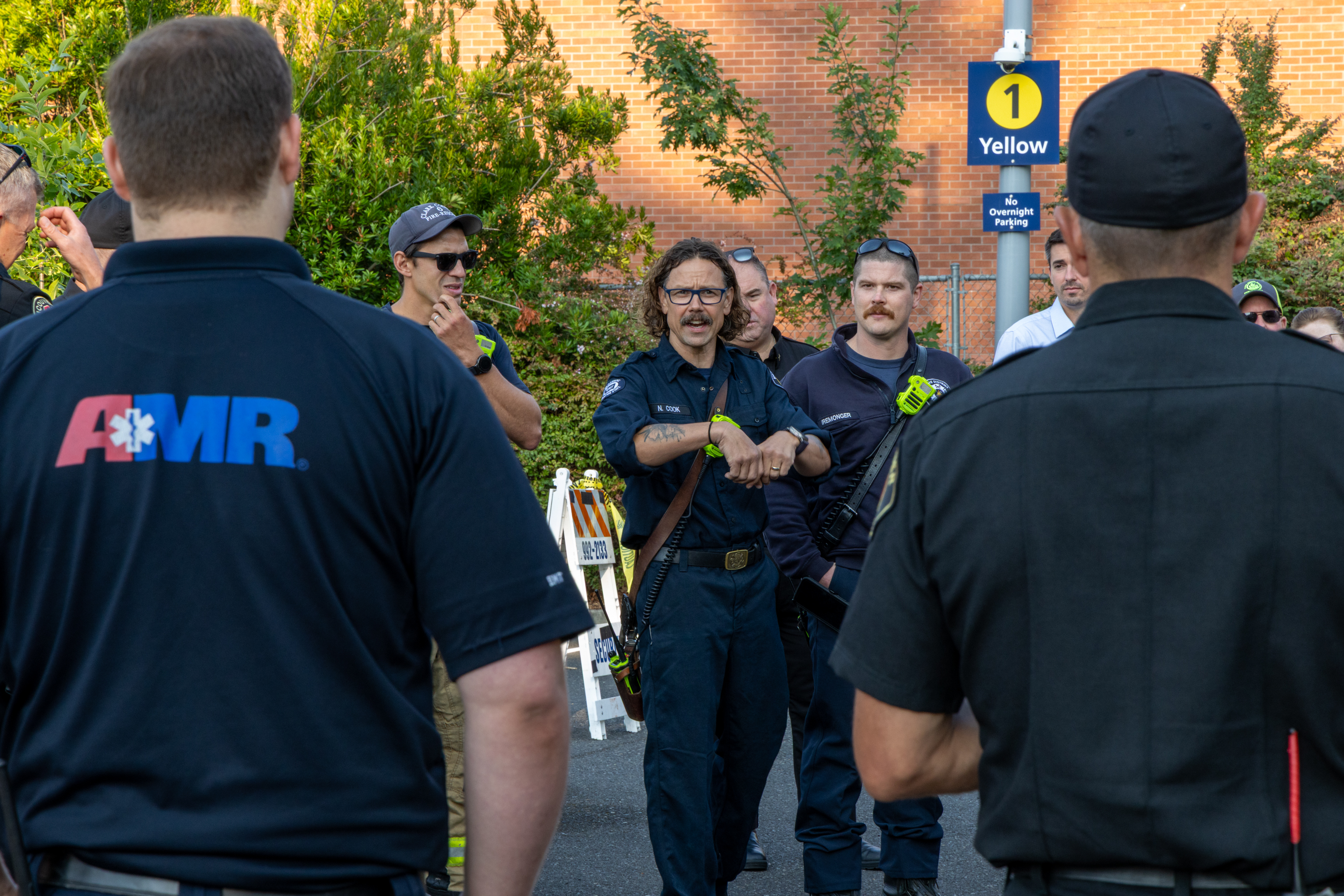
Pictured: Vancouver Police and first responders participating in an active threat drill at Clark College, Sep. 2025
In an emergency, the first few minutes matter. During “Real Talk, Real Response: Understanding Active Threat Incidents,” participants learned that most active threat situations are over in less than 10 minutes. The training, held on March 9, was the third installment of the Emergency Preparedness training series.
Presented by Emergency Manager Lindsey McKim, the training gave Clark faculty and staff an opportunity to learn from past incidents on educational campuses and consider how members of the Clark community can respond in an emergency.
“It’s a hard topic, but it’s important we address the realities of these situations,” Lindsey said at the start of the presentation.
In educational settings, the average law enforcement response time is 1 minute and 48 seconds, which highlights how critical the first moments of an emergency can be.
“Today, waiting is no longer an option,” Lindsey said. “Everyone — not just first responders — has a role in survival.”
Run, Hide, Fight Gives Options When Seconds Count
Incidents can unfold quickly. While there is no single “right” response, the Run, Hide, Fight model offers options to help individuals protect themselves and others. Preparation and training can also help reduce hesitation in high-stress situations.
“You don’t have to be perfect,” Lindsey said, “You just have to be ready.”
The model outlines three responses:
-
- RUN: Leave the area if you can. Leave belongings, keep your hands visible so law enforcement knows you are not a threat, and call 911 when you are in a secure location.
- HIDE: If running is not an option, secure your space by locking and barricading doors, turning off lights, silencing devices, and staying out of sight.
- FIGHT: As a last resort, defend yourself if you are in immediate danger. Work with others and use any object at your disposal to help.
A video explaining the Run, Hide, Fight model is available on the Emergency Training Resources page.
Clark College Response to Active Threats
Lindsey also shared Clark’s lockdown procedure. A lockdown may be initiated to limit movement and secure campus spaces after a threat has begun, and it may be used in response to a range of incidents, not only active threats.
This means that individuals should not wait for a lockdown announcement before taking action. Run, Hide, Fight is a personal survival response that should be used immediately based on what a person observes or is experiencing.
Clark’s Security team responds only if it is safe for them to do so, based on the available information. In an emergency, they coordinate with local law enforcement to unlock access points, send alerts, initiate lockdown procedures, and support response coordination. They also monitor campus via cameras and radios and provide first responders with site-specific knowledge.
Supporting Others During an Emergency
The training addressed how to support individuals with access and functional needs. Participants were encouraged to ask before assisting, communicate clearly and calmly, and follow the individual’s lead when possible.
Other considerations include avoiding forcing someone to act if they’re not ready, assuming everyone responds to emergencies in the same way, taking control without explaining intent, or putting yourself in danger if escape is possible.
While helping others is important, Lindsey reminded the audience that their own safety also matters. Sometimes, the best way to help someone is to get yourself to safety before seeking help for others.
Law Enforcement Response
Sergeant Lagerquist from the Vancouver Police Department was available after the presentation to answer questions about law enforcement’s during an active threat.
When officers arrive, their initial focus is to locate and stop the threat. They move toward active indicators, such as loud disturbances or injured individuals. While they also carry medical supplies, addressing the immediate danger remains their top priority.
One audience member asked who they should call if there is an active threat. Both Lindsey and Sergeant Lagerquist agreed that the first call should be to 911, not Clark Security. Even if you are unsure, it’s better to report concerns so responders can address the situation.
To support a coordinated and efficient response, calls made to 911 from a Clark phone also notify Security, allowing both dispatch and campus personnel to receive real-time information about the situation.
A Staff Member's Experience
At the end of the training, staff member Jami shared her experience during an incident on campus two years ago. She answered audience questions, offering both reassurance and perspective to colleagues.
Lindsey closed the session by reminding participants that safety is a shared responsibility, and preparation is an act of care for yourself and those around you.
Additional Resources
24/7 Campus Security: 360-992-2133
Guardian App: Text “Guardian” to 67283 to receive alerts, discreetly contact security, enable safety timer, and discover campus resources.
Support & Safety Reporting: CARE Team, Title IX, Bias-Based Incident, Student Complaint, Student Conduct
Mental Health & Wellness: Counseling and Health Center: Support for student wellness, connection to community resources, and access to the 988 Suicide and Crisis Lifeline
Upcoming Emergency Management Training Session
Preparedness Starts at Home
Thursday, Apr. 9, 10–11:30 a.m. in PUB 258 / Open to all faculty, staff, and students. Attendees can enter a raffle to win an emergency preparedness kit.
Presented by Jodi Blackwood, Emergency Management Coordinator, Clark Regional Emergency Services Agency (CRESA): This session covers the essentials of personal and household preparedness, understanding local hazards, creating a family emergency plan, building and maintaining emergency kits, preparing your home for utility disruptions, evacuation, or shelter-in-place, and staying informed through alerts and trusted information sources.
Photo: Clark College/Jenny Shadley
Story by Malena Goerl, Staff Writer, Communications and Marketing