
Penguin Talks Explore How History Shapes Present
Three Penguin Talks examine freedom, community heritage, and human rights
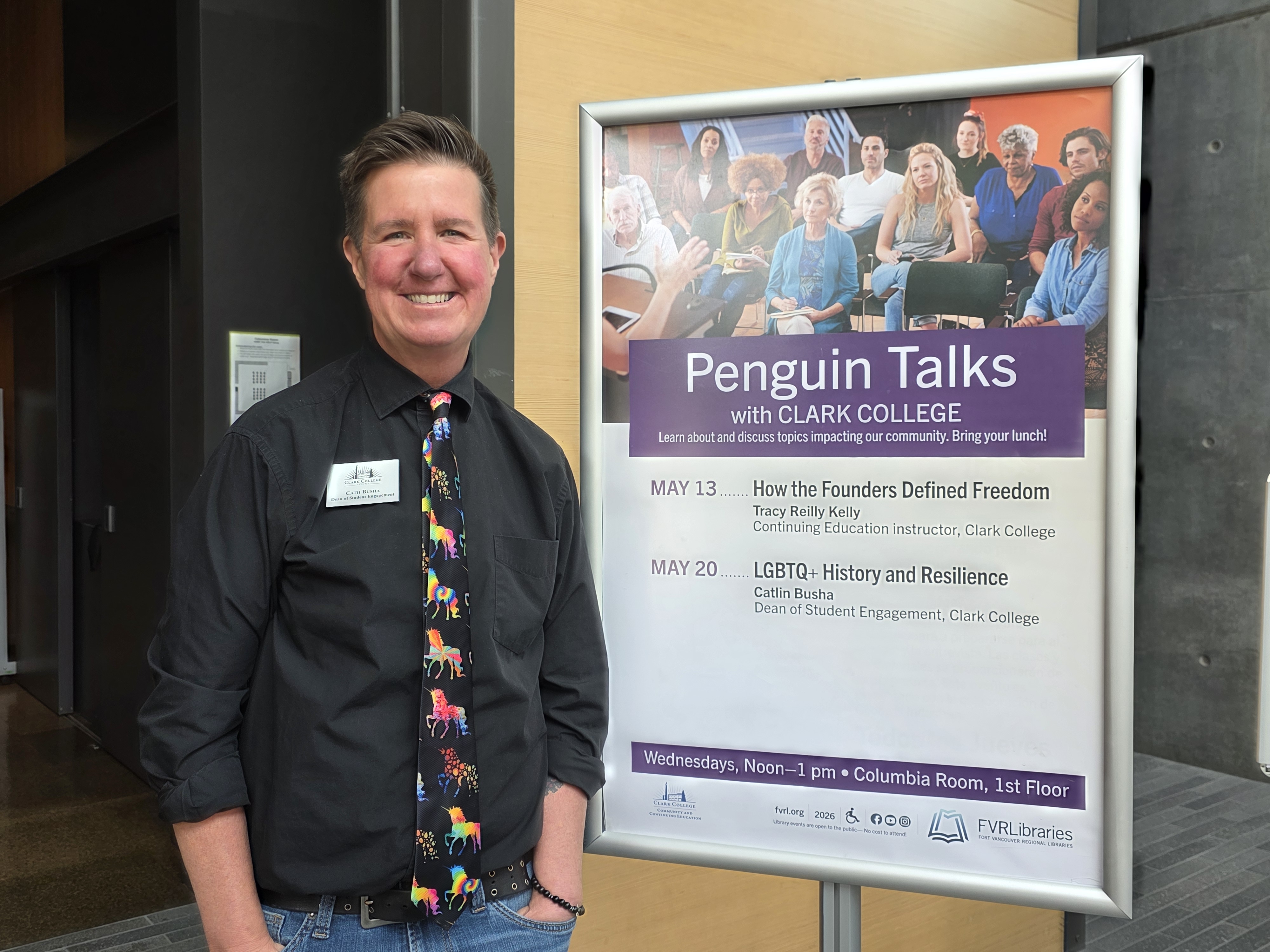 Pictured: Cath Busha, Dean of Student Engagement, presented on LGBTQ+ history and
resiliency at their Penguin Talk at the Vancouver Community Library.
Pictured: Cath Busha, Dean of Student Engagement, presented on LGBTQ+ history and
resiliency at their Penguin Talk at the Vancouver Community Library.History is more than a record of the past — it continues to shape our communities, identities, and understanding of human rights. During this spring’s Penguin Talks series, hosted by Clark College Community and Continuing Education, speakers discussed America’s founding ideals, the people who shaped Southwest Washington, and the evolution of LGBTQ+ identity and rights, exploring the enduring impact of history on communities, culture, and human rights.
How the Founders Defined Freedom
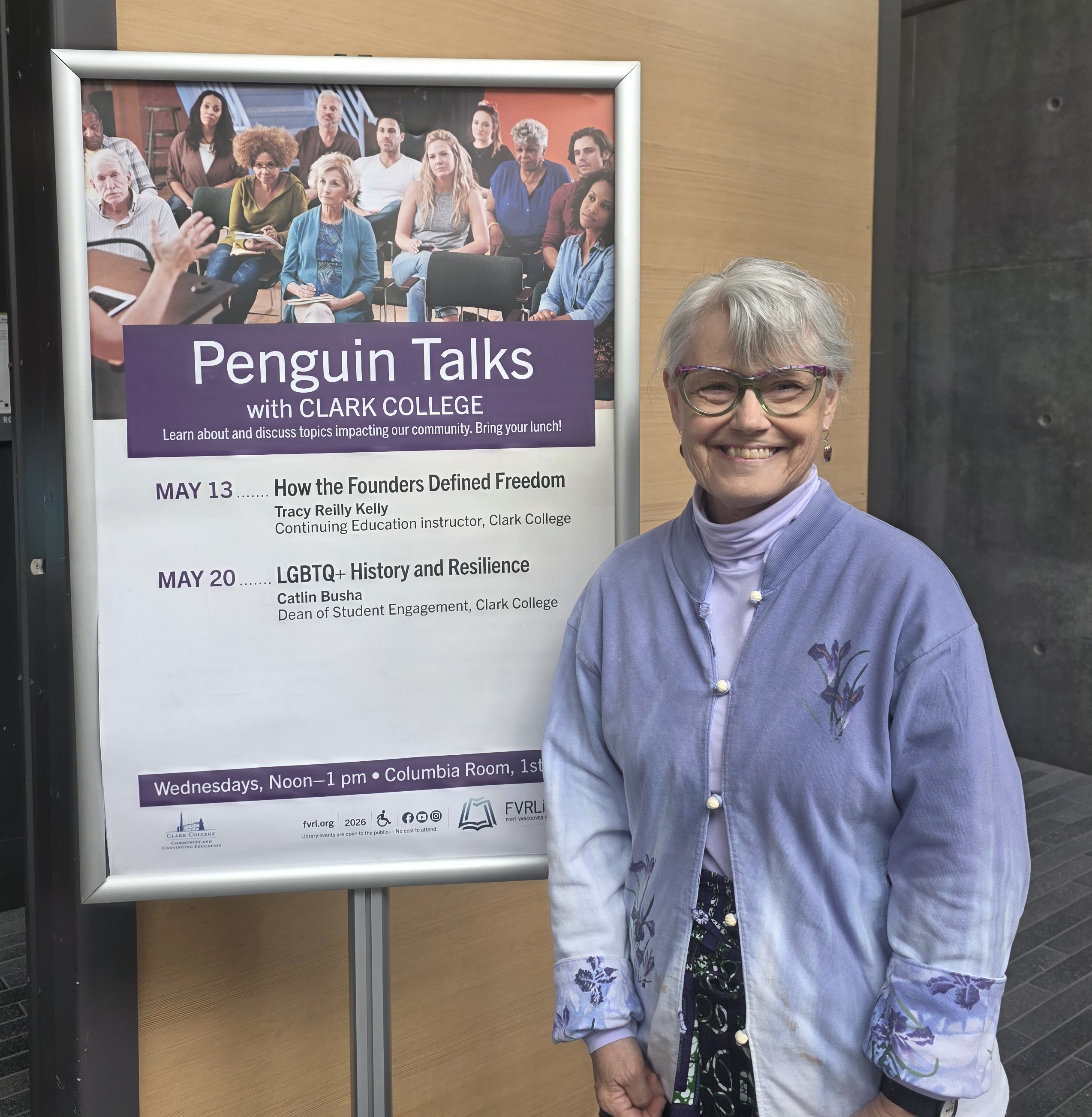 As the nation marks the 250th anniversary of the signing of the Declaration of Independence, Clark CCE instructor Tracy
Reilly Kelly (pictured left) invited the audience to examine a difficult question: how can Americans reconcile
a founding commitment to liberty with the reality that man of the nation’s founders
enslaved other human beings?
As the nation marks the 250th anniversary of the signing of the Declaration of Independence, Clark CCE instructor Tracy
Reilly Kelly (pictured left) invited the audience to examine a difficult question: how can Americans reconcile
a founding commitment to liberty with the reality that man of the nation’s founders
enslaved other human beings?
During her May 13 Penguin Talk, “How the Founders Defined Freedom,” Tracy explored how concepts of freedom and human rights have evolved through American history. She shared some startling truths with the audience: 41 of the 56 Declaration signers and almost half of the men who wrote the Constitution owned slaves; and among the first 18 U.S. Presidents, 12 owned humans at some point, and nine of those had enslaved people working in the White House.
“They were fighting for liberty ... but were they also fighting for equality?” Tracy asked. “If they were, what did that look like to them?”
According to Tracy, the founders’ understanding of liberty differed significantly from modern interpretations. Drawing on historical documents such as the Magna Carta of 1215, she explained that many colonists viewed freedom through the lens of the rights of an Englishman, including protections related to property ownership and self-governance. But, in the late 18th century, they started to wonder if they then had a right to rebel if these rights were denied.
When the Declaration of Independence was drafted, the founders listed 27 grievances against Britain. Yet the document’s promises did not extend to everyone, nor did the founders expect them to. Women and Indigenous peoples were excluded from the founders’ vision of liberty; Africans weren’t even seen as human and were therefore considered property.
Tracy concluded by examining the Declaration’s famous assertion that “All men are created equal.” While the phrase originally reflected a claim that Americans should have the right to self-government, none foresaw the expansive implications this sentence would have as later generations expanded its meaning into a powerful argument for abolition and broader civil rights.
The Story Behind the Two Rivers Heritage Museum
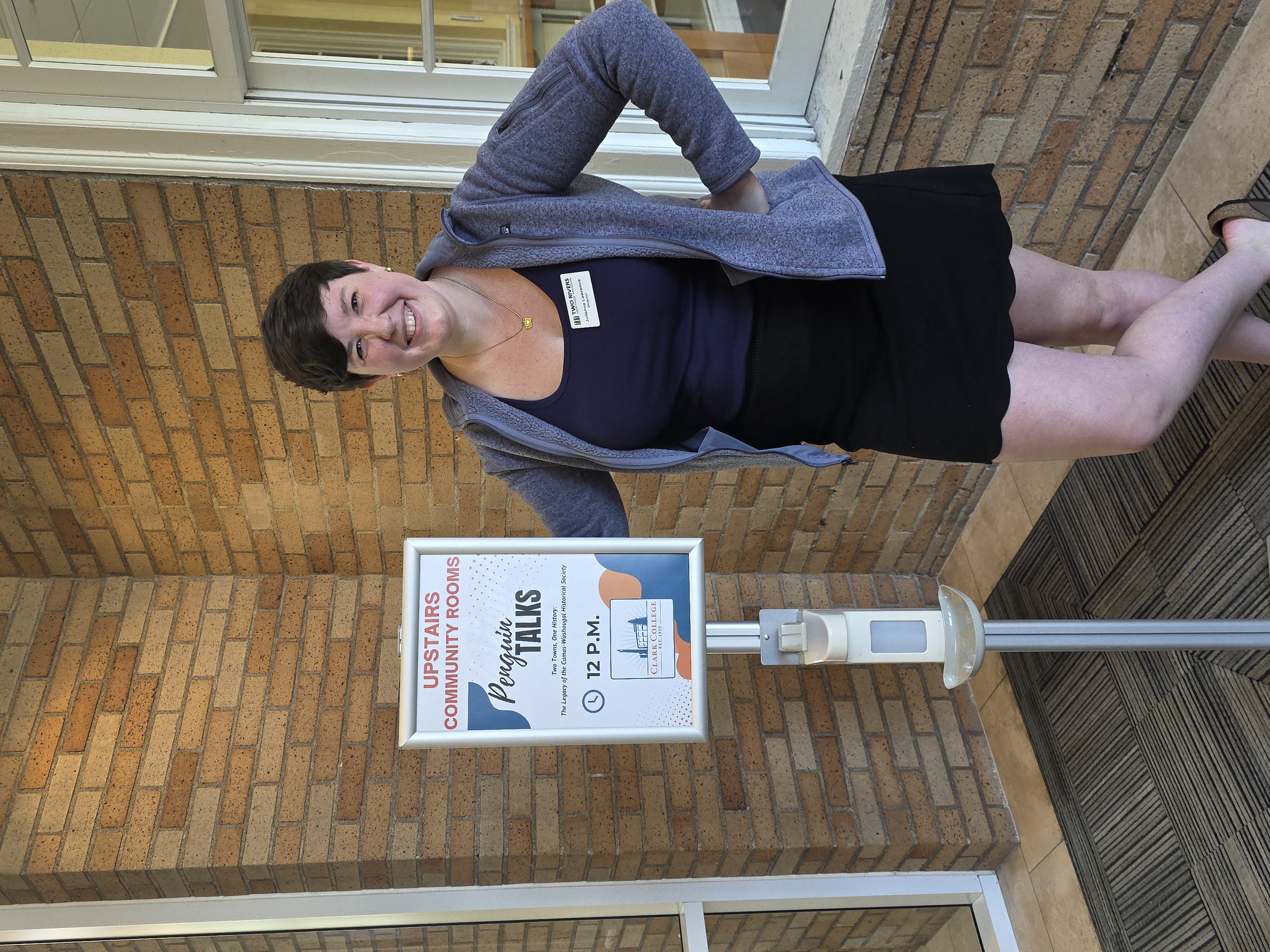
When most people think of a museum, they think of a building. During her May 18 Penguin Talk at Camas Public Library, Julianne Lawrence (pictured right), director of Two Rivers Heritage Museum in Washougal, instead traced the history of a piece of land whose story ultimately led to the museum's creation.
The story began in 1845, when David Parker claimed hundreds of acres along the Columbia River and established a township named Parkersville, along with a ferry dock that he called Parker’s Landing. After his death in 1858, Lewis Van Vleet, the administrator of Parker’s estate, discovered that Parker’s land was never legally recorded. Van Vleet auctioned off much of the land but took Parker’s Landing for himself, which continued to thrive as a ferry stop, even after Parkersville declined amid land disputes. He built a house near the dock and made it his family’s homestead.
The land’s history intersected with that of Richard and White Wing “Betsy” Ough, daughter of the Cascades Tribe chief. Bound by a promise that she wouldn’t be taken from her ancestral land, the couple farmed 640 acres, located near Parkersville, for decades. In 1880, they sold a portion of their property along the Columbia River to Joseph Durgin, who then donated some of those acres to establish the town of Washougal.
In 1890, Van Vleet’s daughter, Dr. Louisa Van Vleet Wright — Clark County’s first female physician — purchased Parker’s Landing from her father. After her death shortly after she retired in 1912, Parker’s Landing remained in the family until her son, Cecil, sold it to the Port of Camas-Washougal decades later.
When the Port declared the historic home a safety hazard in 1978, community members formed a historical society to save it and turn it into a museum. Before that could happen, however, an arsonist burned the house down. The Two Rivers Heritage Museum’s first collection featured metal artifacts salvaged from the site, along with personal donations from local families’ collections. The museum first opened in the library’s basement before moving to their current location in 1996, where they’ve continued expanding. Despite the museum not standing at the former site of the Van Vleet home, Julianne emphasized that its roots remain tied to the generations of people who shaped the land (and now a park) called Parker’s Landing.
Making Room for the Good
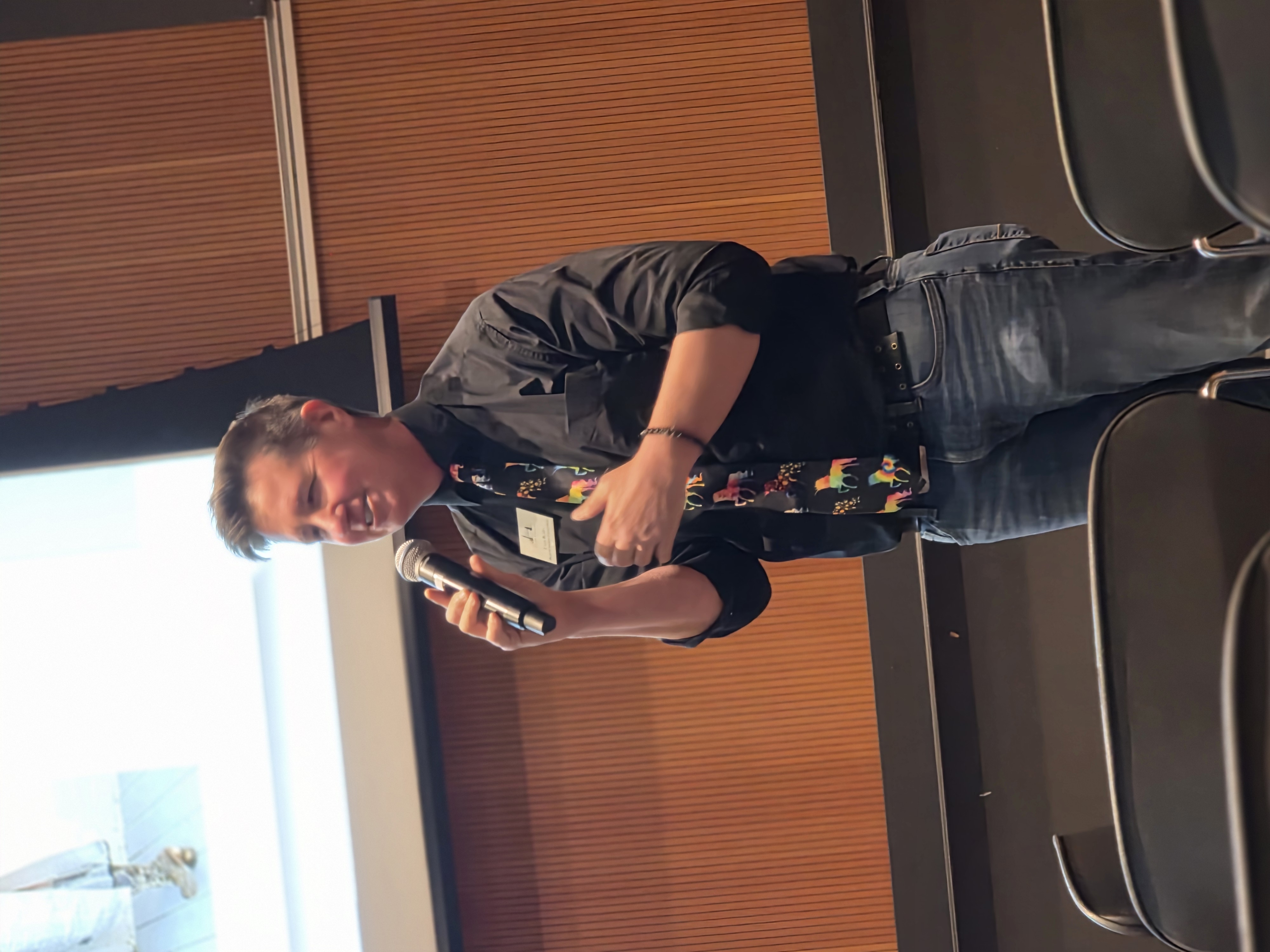 Ahead of Pride Month, Cath Busha (pictured left), Clark’s Dean of Student Engagement, delivered a May 20th Penguin Talk that blended LGBTQ+ history with their personal journey, highlighting
themes of identity and resilience.
Ahead of Pride Month, Cath Busha (pictured left), Clark’s Dean of Student Engagement, delivered a May 20th Penguin Talk that blended LGBTQ+ history with their personal journey, highlighting
themes of identity and resilience.
From growing up in Amish country as a self-described tomboy to building a career supporting students in higher education, Cath wove their own experiences together with milestones from LGBTQ+ history, including events such as the election of Harvey Milk as California’s first openly gay elected official and the establishment of National Coming Out Day in 1988.
After college, Cath taught middle school while privately acknowledging their queer identity — but sharing it with no one. Years later, after moving to Philadelphia, they decided they no longer wanted to hide.
“Whatever I do, I want to be out. I don’t want to hide anymore,” Cath said.
A later move to Tucson, Arizona, brought opportunities to work with youth and began to discover the language that fit their identity, along with combating the identities others assigned to them. As they continued moving up the West Coast and working in higher ed, Cath found purpose in supporting students on their journeys.
Cath ended their talk by sharing findings from a study that asked members of the queer community what they like about their identities. Common themes emerged in their responses: personal growth, resilience, self-understanding, the ability to form meaningful relationships and communities, gaining an expanded worldview, and empowerment. The responses are a powerful reminder that even amid challenges, there is value in making room for the good.
Learn More About Clark's CCE Program
Clark College Community, Continuing Education, and Customized Training program serves nearly 8,000 learners each year through community classes, certificates, CEUs, testing services, and customized workforce training. The program provides high-quality, relevant learning opportunities for lifelong learners and partners with local industry to deliver quick-turn training that strengthens Southwest Washington’s workforce.
Learn more about CCE, their spring class offerings, and upcoming Penguin Talks on the CCE website.
Photos: Clark College/Malena Goerl
Story by Malena Goerl, Staff Writer, Communications and Marketing