
Spring 2026 Art Talks
Local artists join Clark students to share their experiences in different creative fields
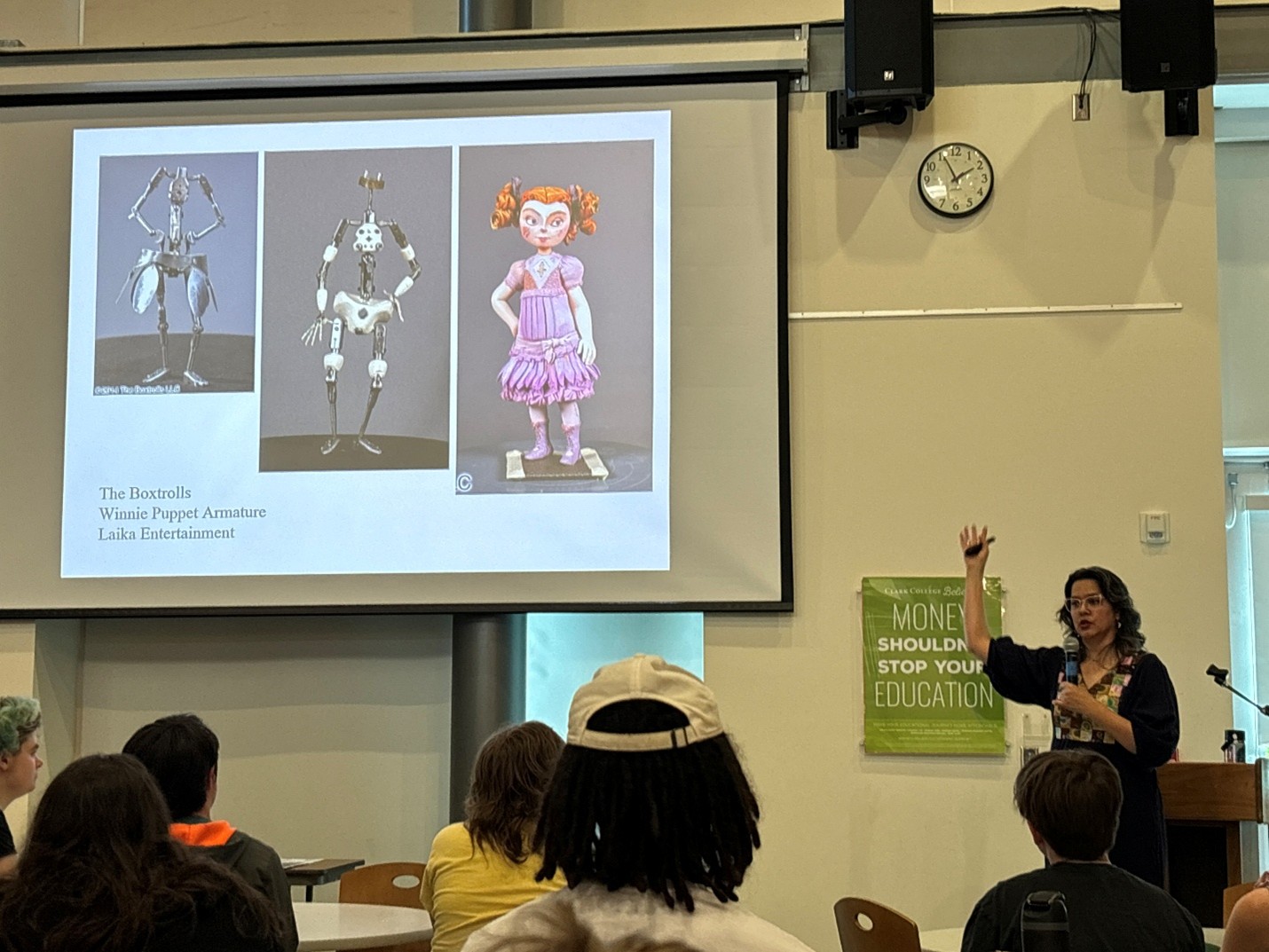
Adapting in Creative Fields
You may have seen some of Miel-Margarita Paredes’ contributions to well-known projects such as Guillermo del Toro’s Pinocchio (2022), ParaNorman (2012), or The Boxtrolls (2014). What you may not know is that she creates the metal skeletons—called armatures—inside stop-motion figurines, custom fit for each character.
Miel-Margarita (pictured above) is a metalsmith who creates sculptures, wearable armor, toys, and stop-motion animation armatures. During her visit to Clark College on April 30, she shared stories to a room full of students about what it’s like working in stop-motion animation remotely during the COVID-19 pandemic, maintaining work as a freelance artist, and the inspiration behind her original works.
Much of Miel-Margarita’s original works are inspired by the treatment of animals as commodities, bringing concepts to life from various metals—often bronze—to create sculptures, interactive toys, armor, and accessories. When she isn’t creating larger sculptural works or working on projects with the animation studio Laika, Miel-Margarita finds other ways to make an income, like making and selling jewelry. She shared her insights on what it’s like juggling multiple contract or freelance jobs as an artist.
“As an artist, you need to pivot,” she said, explaining that being adaptive is critical to maintaining a creative career, especially when your work is niche.
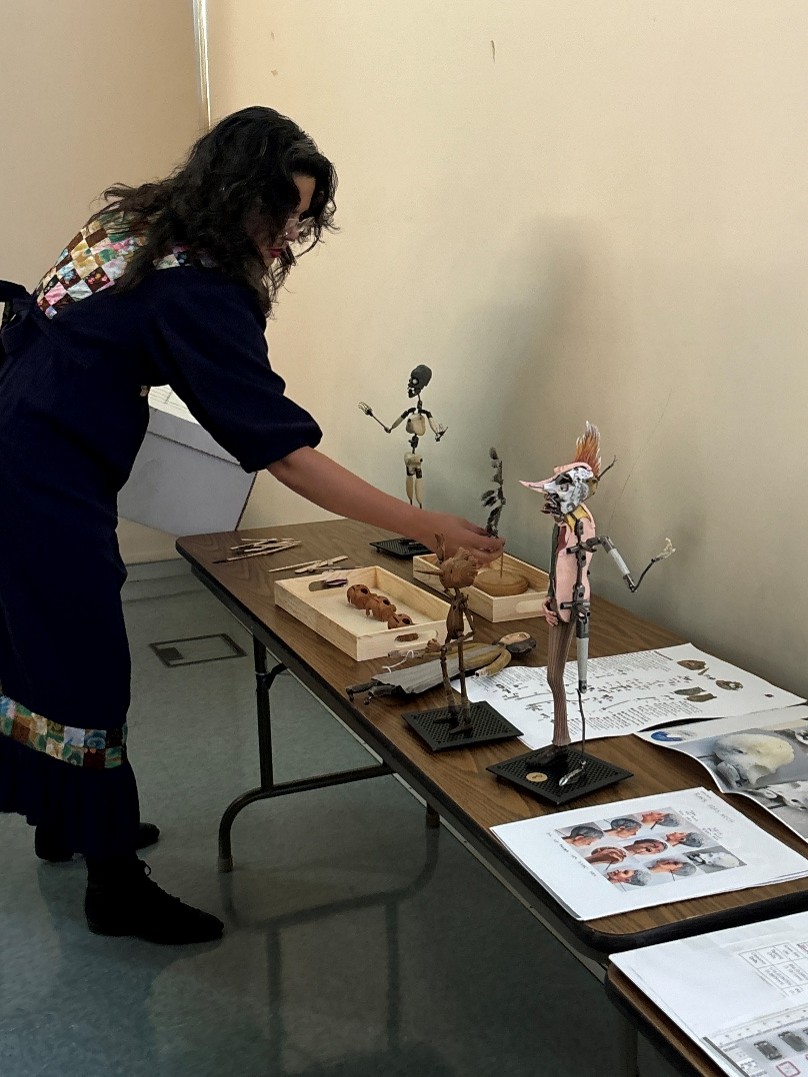
Pictured: Miel-Margarita setting up armatures and other models from animation projects she worked on, including photos of design details.
Nostalgia Through Multimedia Artwork
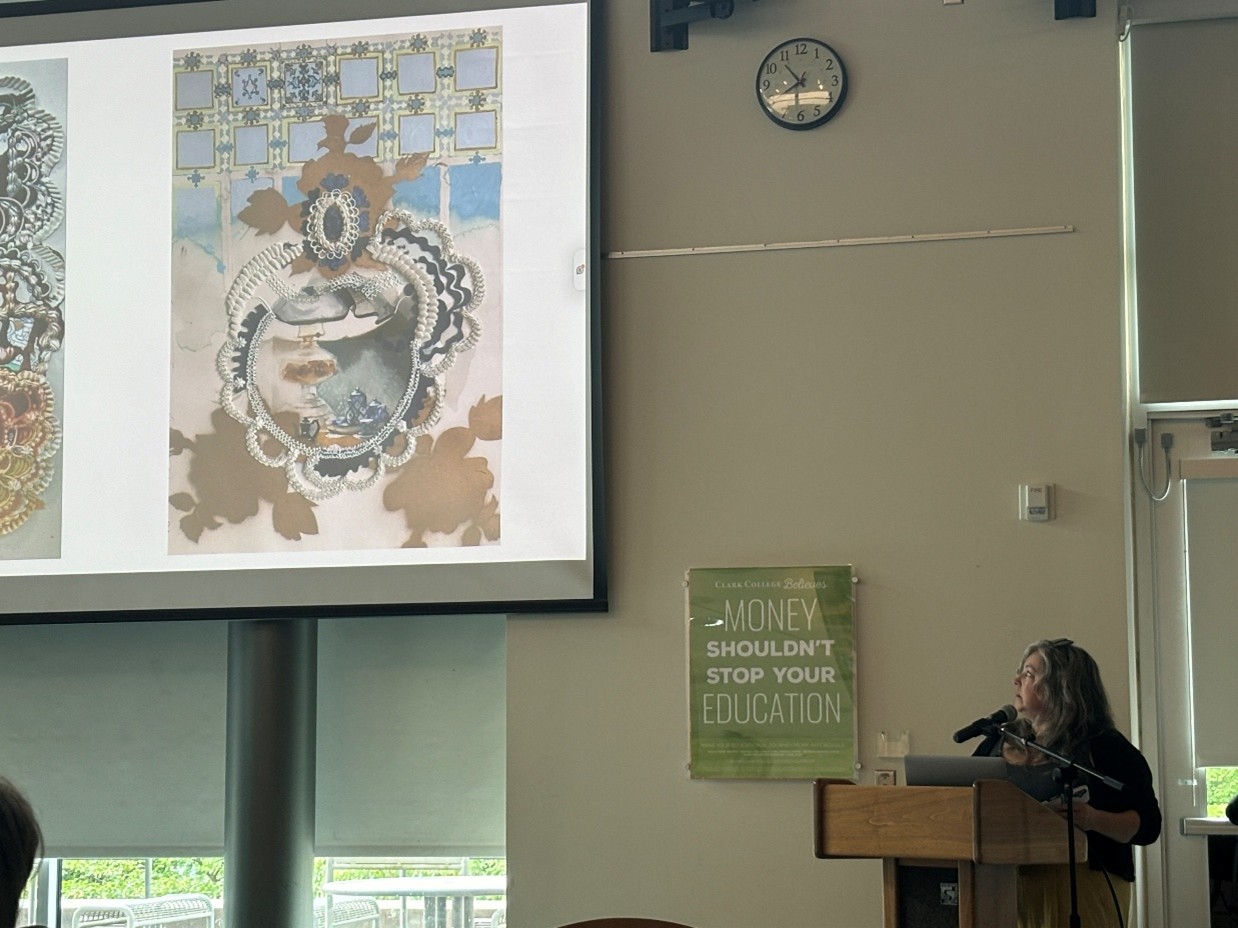
In May 4, Bonnie Paisley (pictured left) joined Clark students to share the inspirations behind her artwork and the evolution of her works over time. Bonnie is a multimedia artist with pieces that combine collage, sculpture, animation, and cake-decorating elements. She draws from her experience as a woman and a mother while creating elements of nostalgia through her visuals.
“Nostalgia can be dangerous,” said Bonnie, “but I’m interested in a more reflective nostalgia.” She evokes these feelings through her use of vivid color and immersive sculptural pieces.
When looking at Bonnie’s work, it’s easy to notice piped details used with cake-decorating tools. Cakes bring a sense of messiness and maximalism to her work, so she taught herself cake-decorating techniques with Wilton instructional books—but with acrylic paint instead of icing. Bringing this unconventional tool into painting and collage brought a three-dimensional element to her work that evolved into sculpture.
As Bonnie’s career evolved, she opened a community art studio in Portland called Paisley Studios. It is a studio for wxmen (cis, queer, and trans) artists to create with confidence in a welcoming, creative environment.
Femininity Out of Abstraction
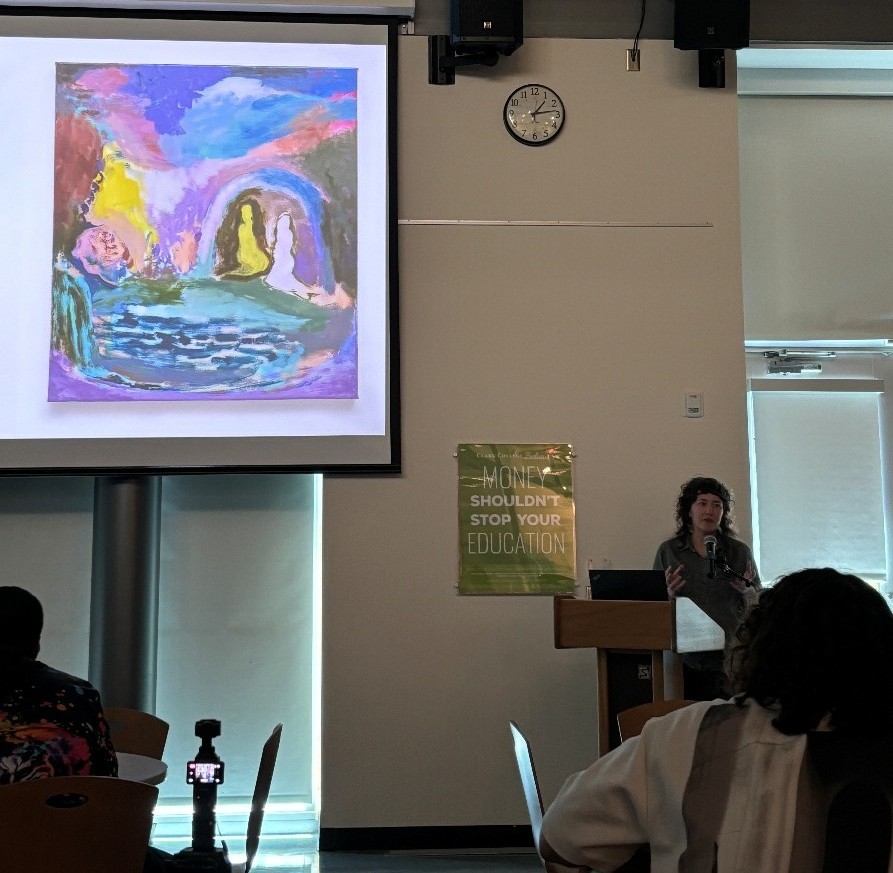
As an artist who is exclusively an oil painter, Anya Roberts-Toney (pictured left) brought her expertise in the medium to art students at Clark on May 7. Anya has always been fascinated with femininity in artwork, but after learning about the historical objectification of women in Western artwork, Anya reformatted her approach of painting female figures through abstraction—granting the subjects autonomy. She described the way she blurs the figures, making them shift into the background as a way to restrict the viewer’s access to the women.
“The unknowable can be feminine power,” said Anya.
This abstraction plays into a mysterious “dream” that she creates with her paintings. Despite the abstract style, recognizable elements such as fountains, pools of water, and nature can be pieced together by the viewer to fill in a story. Certain motifs like arches and “bursts” tend to appear in her paintings regularly, functioning as metaphorical portals to a new realm.
When talking about her work, Anya also highlighted the importance of inspiration in the creative process. She shared pictures of her studio, where she has many printed images of artwork that inspires her, and a couch where she can relax with a book of poetry while taking breaks from painting. Anya finished her talk on a logistical note by recommending specific oil painting techniques, brushes, and paints.
Surrealism in Landscapes
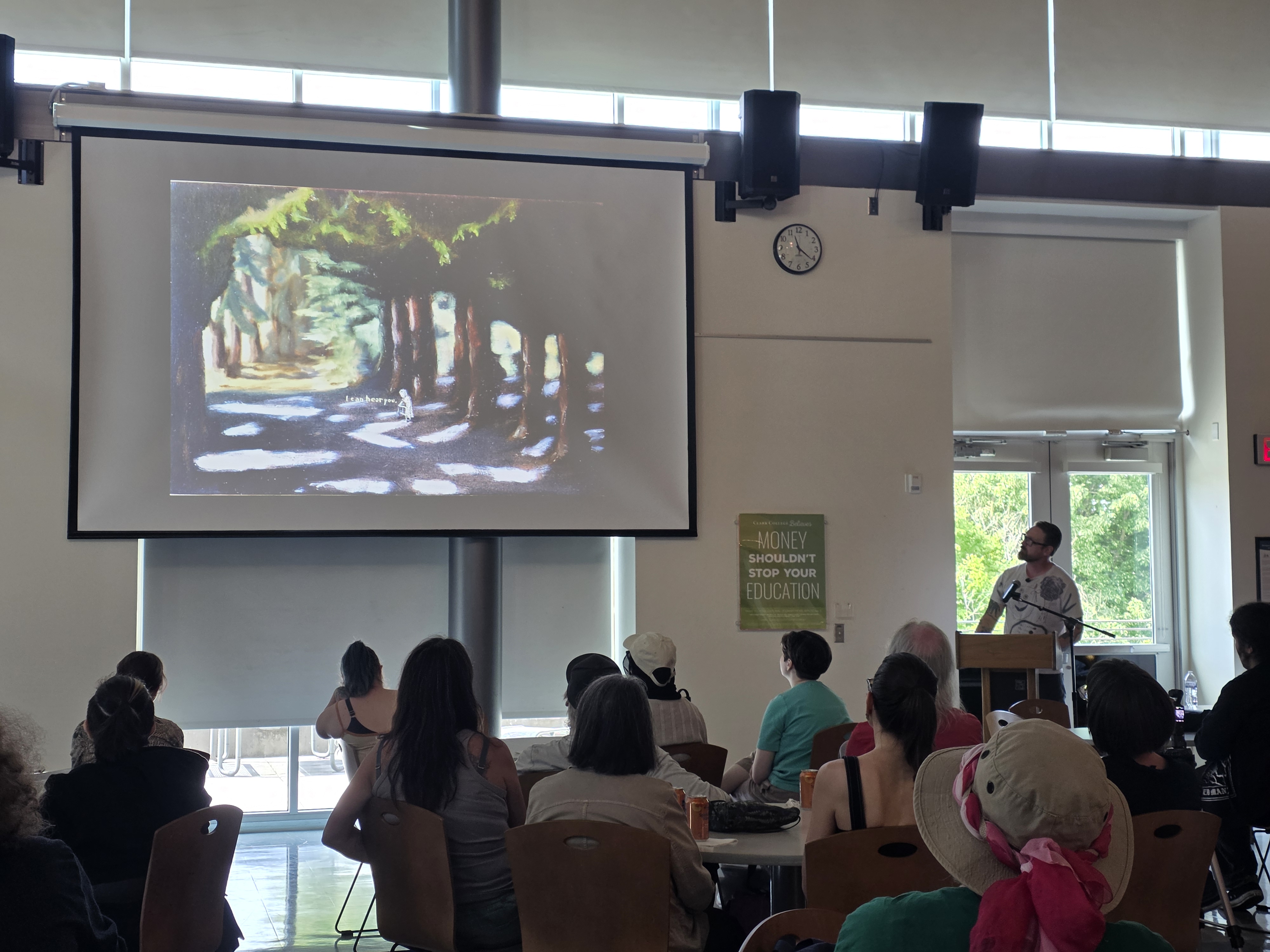
Dan Attoe (pictured left) joined Clark students on May 12 to discuss how he pursued art as a career despite early limitations. Dan has been invested in creating artwork since childhood, beginning painting at only 14 years old. Despite his love for painting, the lack of opportunities to pursue the career path when he was younger led him to choose psychology instead. He continued to create art alongside his work in psychology, but eventually dropped the latter to give all his time to art. The high cost of canvas led him to paint on whatever was accessible, such as beer bottles and doors.
“I painted whatever I was drawn to every day,” he said.
Dan’s work is influenced by rock music, but much of his inspiration evolved from bits of his childhood and the nature around him. He couldn’t help being drawn to landscapes, and he often incorporates elements of surrealism with symbols like neon signage. Dan talked about his recent paintings inspired by rural America, rebelling against typical ideas of landscapes in a deconstructed way.
“I grew up hating landscape paintings because they were everywhere … similarly, neon is everywhere, but it occupies a place in rural American language,” Dan said.
Painting as a Form of Expression
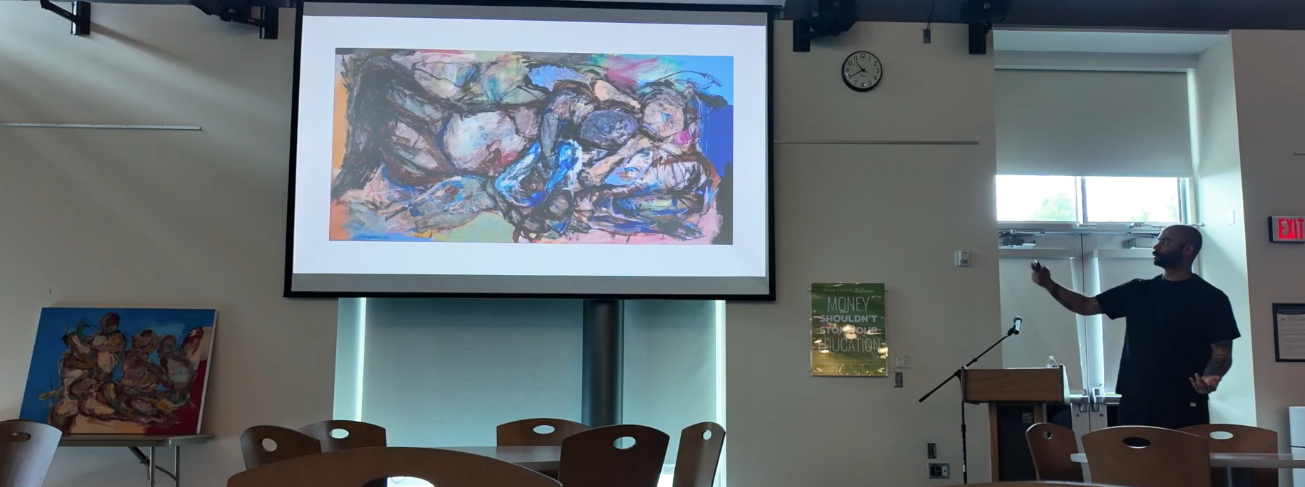
From professional rugby player to painter, Malon Al-Jiboori’s range of unique experiences have shaped his artwork. On May 19, Malon (pictured above) shared the details of this shift in his career. Malon’s background in rugby led him to be surrounded by a suppressed, hyper-masculine environment. Without much room to express himself freely, he felt restricted until he turned to painting.
To Malon, a canvas is like a journal. He paints on a single canvas, again and again, building layers that tell a story—one of humanity and how people connect despite their differences.
“Closeness can both ground and unravel us,” said Malon.
During his time as a rugby player, Malon traveled to many states across the U.S. and regions of the U.K., which influenced his view of culture and connection, and the unity that can exist in humanity.
Being a self-taught artist, Malon found his way in the art scene on his own. Once he moved to Portland, he found his home in a collective of artists called Blackfish Gallery. He shared the ins and outs of what it is like to join a collective, and the freedoms that come with working in a collective over standard galleries.
Connect with Creativity
Keep up with each of these amazing artists to see what they create next!
The Archer Gallery, located in the Penguin Union Building on Clark’s main campus, has seasonal exhibitions. The current exhibition is the Art Student Annual Exhibition, showcasing Clark art student works from now until June 11, 2026.
Phoenix, a juried art journal published by Clark College featuring artwork by students, will be unveiled at the Archer Gallery on June 11. Stop by for a free copy between 1–3 pm in conjunction with the closing reception of the Art Student Annual Exhibition.
Photos: Clark College/Masha Yaremenko and Malena Goerl
Story by Masha Yaremenko, Digital Media Student Intern, Communications and Marketing