
Engineering Students Race to Aid Oswald
Engineering design competition addresses mobility issues and assistive technology
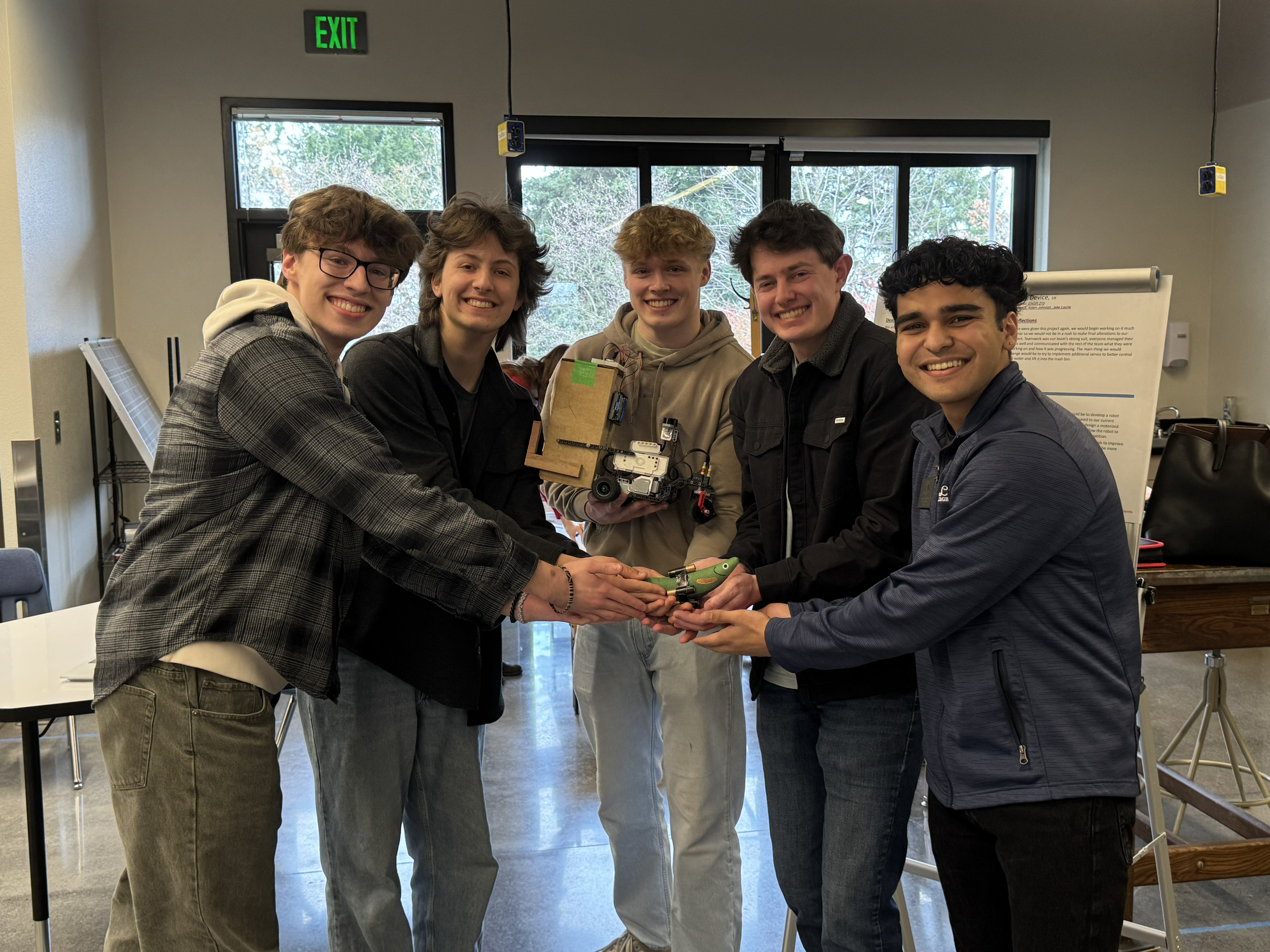
Pictured: Engineering students hold their robot at this term's design competition
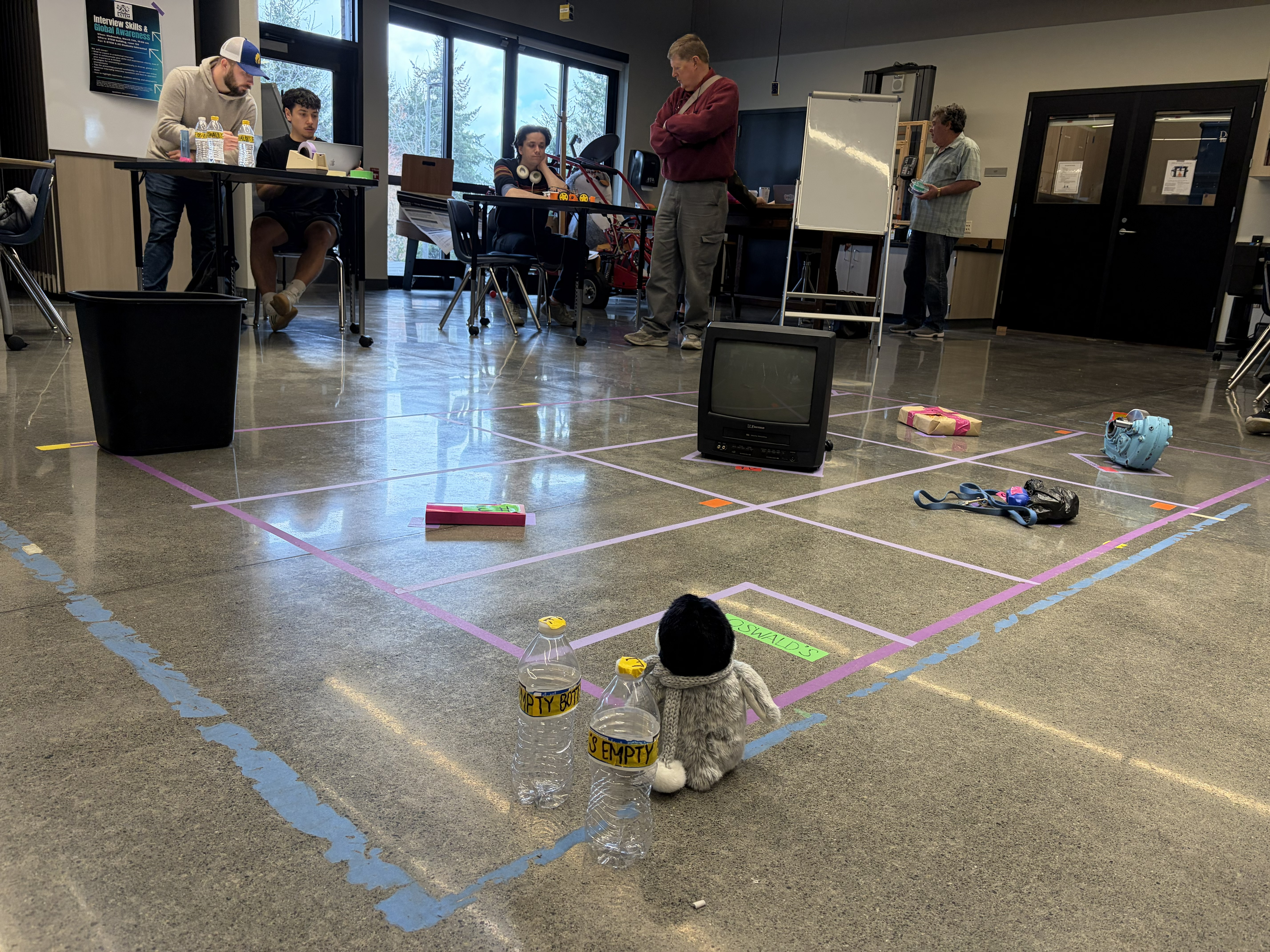
Engineering students came to Oswald’s rescue for this term’s design competition, “Mobility Aid Robot,” on March 10.
This winter term, students are tasked with designing and building a mobility-aid robot that could navigate its environment, avoid obstacles, and deliver a water bottle to Oswald — who was “temporarily confined to bed” — students applied the engineering design process to create safe, reliable, and user-centered assistive technology.
Mobility issues and difficulty retrieving everyday items affect many people, so the goal of the project was to help restore independence and improve quality of life.
Unfortunately for the stuffed Oswald, who sat patiently on one side of the competition area, the day's theme became trial and error. Many students were pleased simply to get their robots moving in the right direction.
On Team Push Pot, one member said, “Our motto was, ‘Keep it simple, stupid,’ and it worked for the most part. We ran into a lot of issues. It moves, which is a lot more than other people can say about theirs. But I spent three weeks trying to make it go straight, and it doesn’t.”
Greyson Roper added, “The turning was nice. It was our pride and joy of the project.”
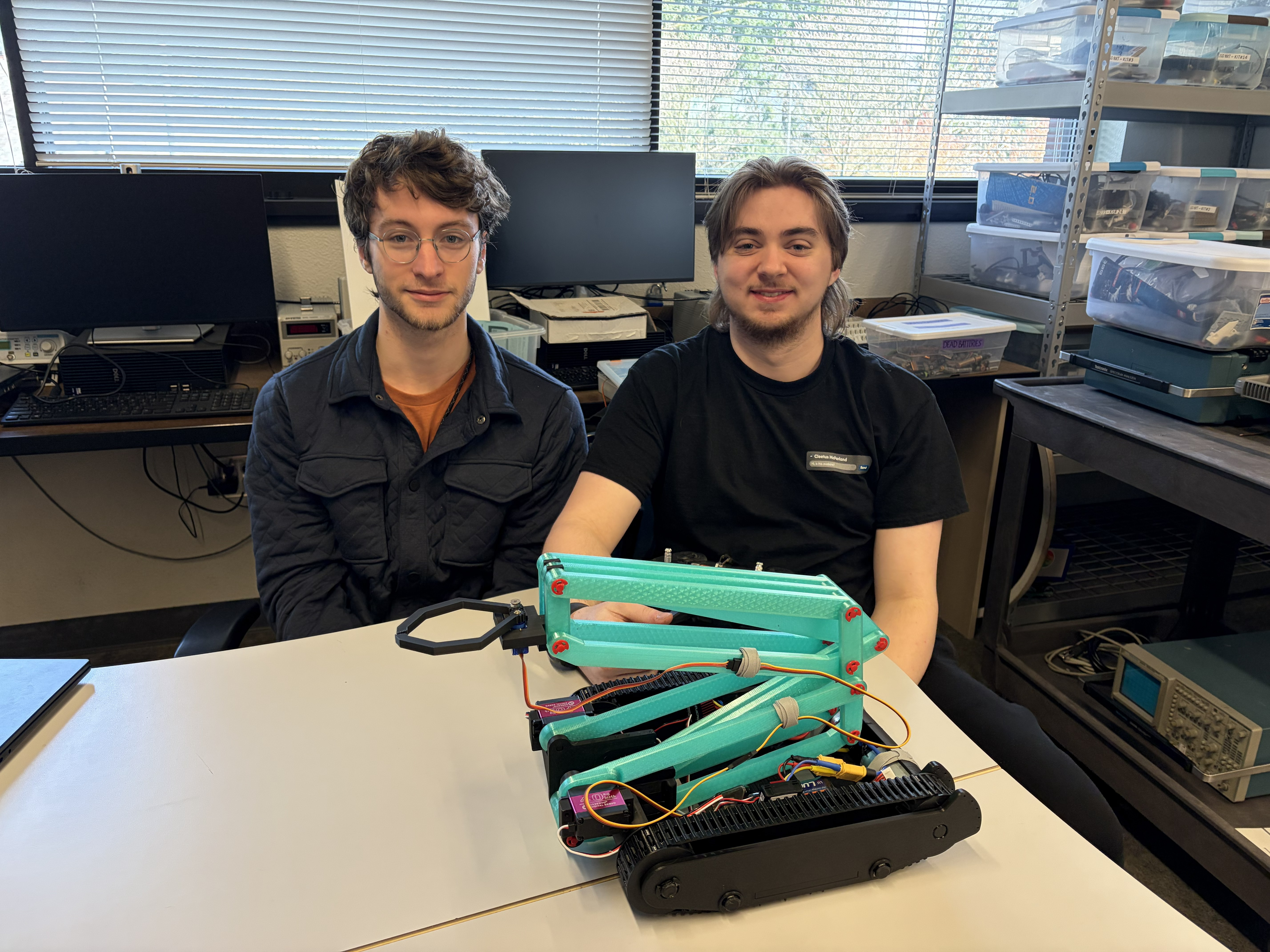
Each team was given a budget to purchase materials, influencing some of their design choices.
On Team Pengu-Mon (pictured right), mechanical engineering student Max DuCom chose to 3D print nearly all of the parts used in his team’s robot.
“Hardware costs add up, so it’s also a cost-saving measure,” he said.
While many robots were unable to fully complete the challenge, the project remained a valuable learning experience. Students walked away with a better understanding of what works — and even more of what doesn’t work.
“I usually just free-build. But I learned a lot about the design process,” said Josiah Ameling. “It was worth it,” he added, despite it being more time-consuming than free-building.
From Team Triangle, Shea Reis said she gained a better understanding of the design process.
“I learned about spotting issues before they happened, and how 3D-modeling and sketching,” she said.
She perfectly summed up the overall sentiment of the competition: “We failed in a fun way.”
After the competition, students celebrated Pi Day early (3.14 — the first three digits in the mathematical constant pi) with pie made by the McClaskey Culinary Institute. Students were excited to end the tough competition on a sweet note.
Learn More About Engineering at Clark
Clark’s engineering department has one of the largest and most affordable transfer programs in Washington, allowing students to build a solid foundation in their discipline while taking advantage of small class sizes.
Each term, engineering students take on different hands-on projects, with instructors posing real-life problems for them to solve—experiences that build technical confidence and resilience. See last term’s student creations and learn more about Clark's Engineering department.
Photos: Clark College/Carly Rae Zent
Story by Malena Goerl, Staff Writer, and Carly Rae Zent, Digital Media Specialist, Communications and Marketing