
Celebrating International Education
Tibetan monks construct sand mandala on campus, encourage cultural connection
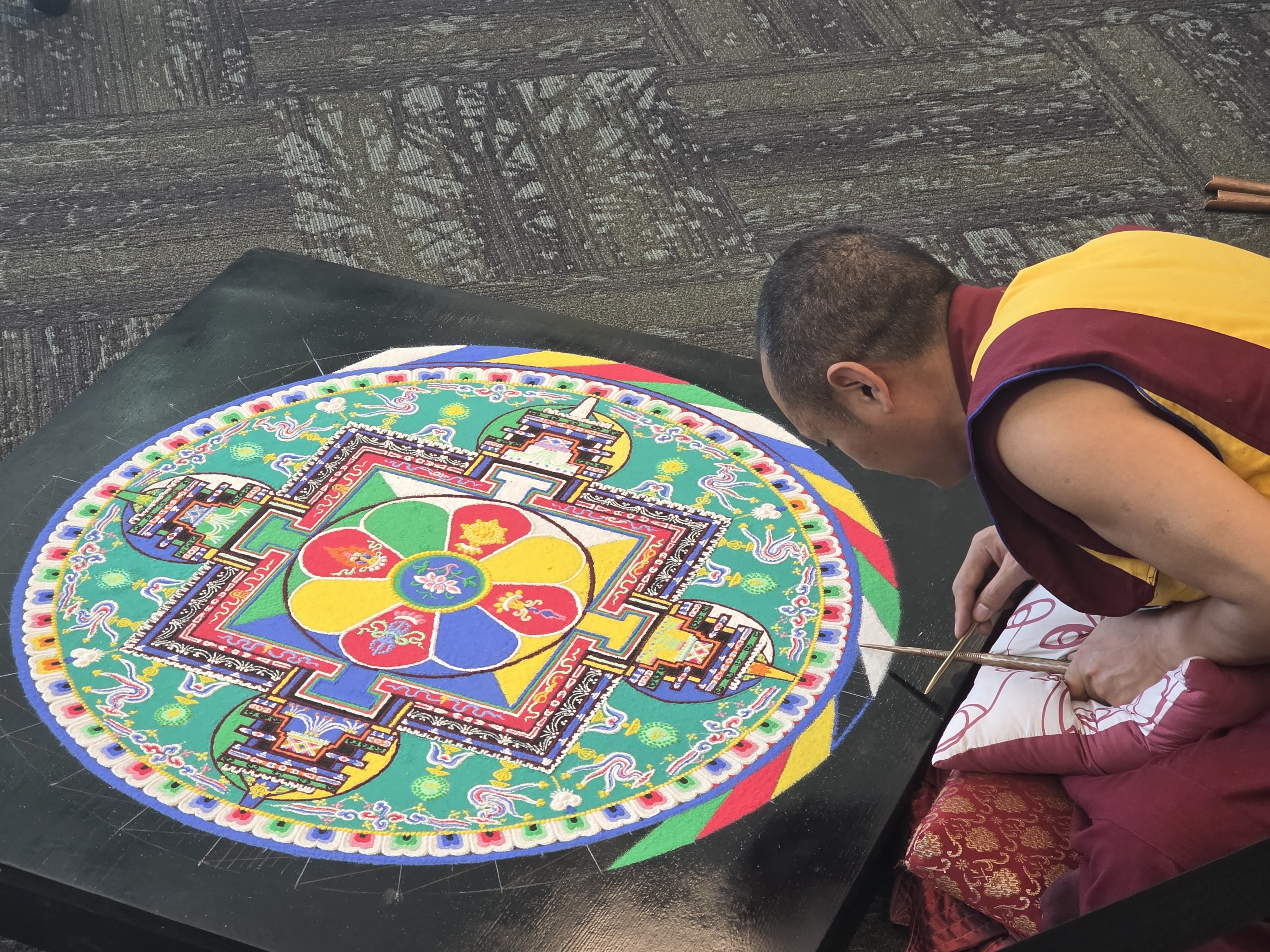
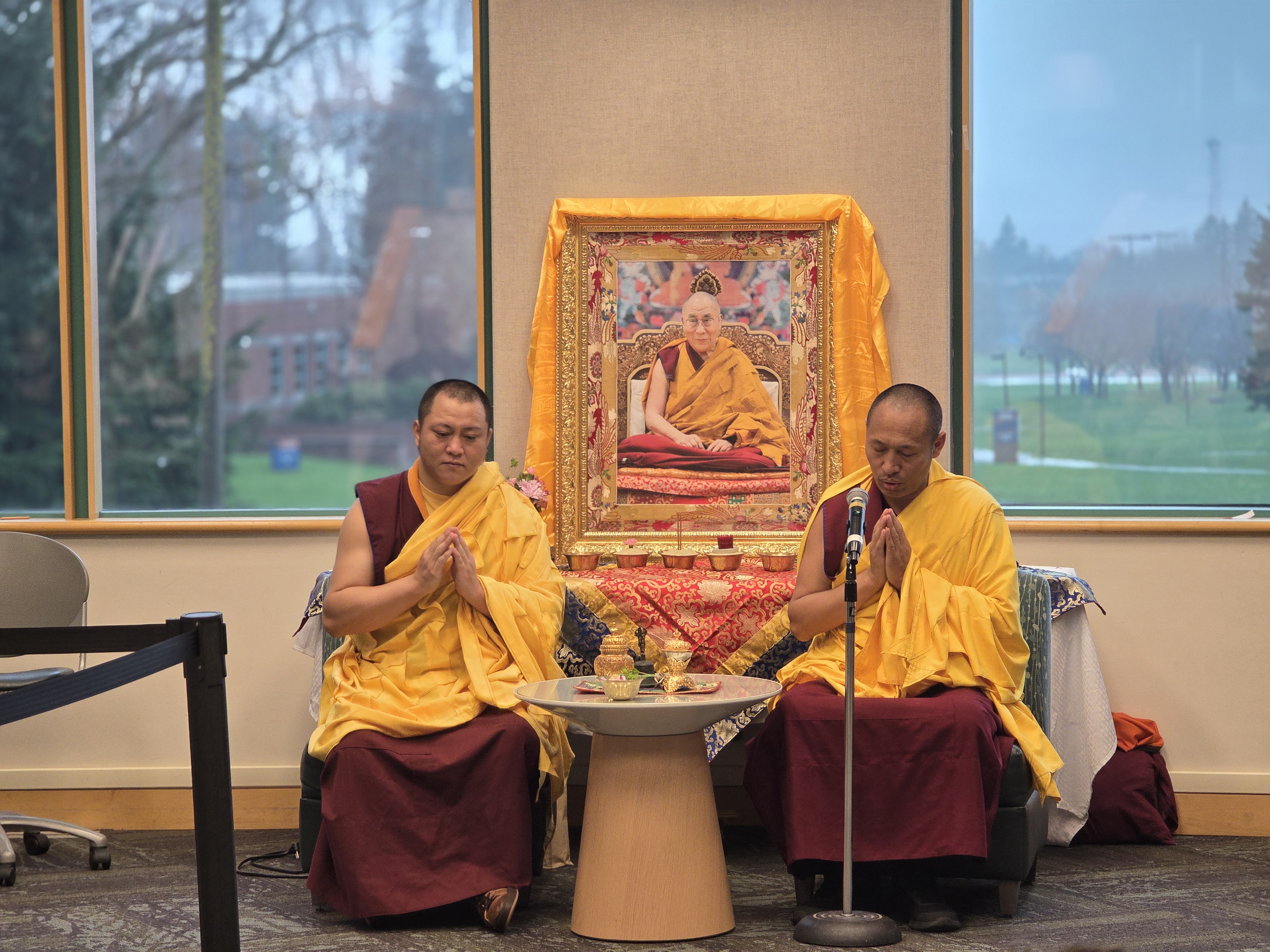
Cannell Library’s hum of quiet productivity took on a new rhythm the week of Feb. 23: the gentle tapping of a chak-pur as a Tibetan monk carefully constructed a traditional sand mandala.
This is the fifth time Clark has hosted a mandala construction on campus in celebration of international education. The event was sponsored by Clark’s International Programs, Clark College Libraries, and the Dharma Light Tibetan Buddhist Association of Vancouver.
In the Tibetan Buddhist tradition, the creation of a sand mandala is intended to generate a profound experience of compassion and healing. It is believed that the positive energy of a sand mandala radiates outward for world peace, offering blessings throughout the entire region, the environment, and the surrounding community.
Lobsang Dawa, one of the visiting monks, added that their intention for this event was to strengthen cultural exchange and promote the sublime meaning of the mandala culture.
Constructing with Meditative Concentration
Mandala creation is not a skill taught to all monks — how many monks learn it depends on each temple’s needs. Those who choose to pursue it study the art and meditation of the mandala for three years.
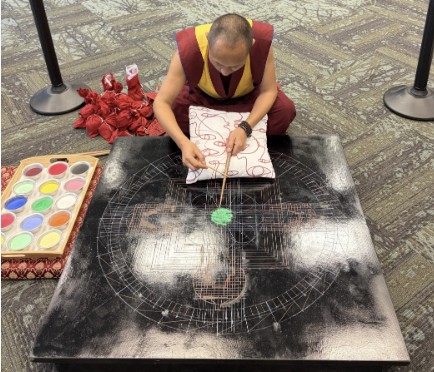
The night before construction began, the monk constructing the mandala, Lobsang Dhargyal, drew the pattern on the platform. A mandala creator must memorize every detail — they cannot take creative liberties. Normally, up to eight monks construct a mandala, but because of the snowstorm on the East Coast, only Dhargyal was present to complete it.
The actual construction of the mandala requires intense and meditative concentration. The monk fills a chak-pur — a traditional Tibetan tool — with sand, then glides a piece of wood over the ridges of the chak-pur so that the sand flows out in a precise, steady stream. This mandala took around 40 hours to construct.
The Meaning Behind the Design
On Feb. 26, Dawa led a Sacred Tibetan Art Presentation, where he provided details about the mandala’s design:
The patterns on the outer circle are the same across Tibetan sand mandalas. However, the design within the circle varies to reflect the deity that the mandala is dedicated to. The one constructed on campus this year represents Chenrezig, the Bodhisattva of Compassion.
The design is extremely symbolic:
-
- The five colors used (blue, white, yellow, red, and green) represent the Five Buddha Families (or Tathāgatas) and their corresponding wisdoms, elements, and directions. These colors serve as a meditation aid to transform negative emotions into enlightened awareness.
- The lotus petal represents the enlightened mind. Positioned as a protective ring or base, it symbolizes the soul's unfolding.
- The moon and the sun represent the union of compassion and wisdom, symbolizing the union of enlightened consciousness.
- The four gates represent the four noble truths: loving-kindness, compassion, altruistic joy, and equanimity.
- All five colors of sand are from natural plants that are processed, ground, and blessed.
Dawa also answered audience questions that explored the Buddhist culture. “Everybody is a Buddha in their heart,” Dawa said. He explained that Buddha instructs you to think for yourself, study and analyze, and not to blindly follow.
In Buddhism, the Buddha is not a god who grants favors, bestows blessings, or forgive sins. Dawa said, “Buddha can’t bless you. It’s up to you to conquer your emotions.” Instead, Buddha provides the teachings (Dhama) to help individuals focus on mindfulness, mental discipline, and controlling emotions (such as anger and desire) rather than being controlled by them.
Deconstruction: the Art of Letting Go
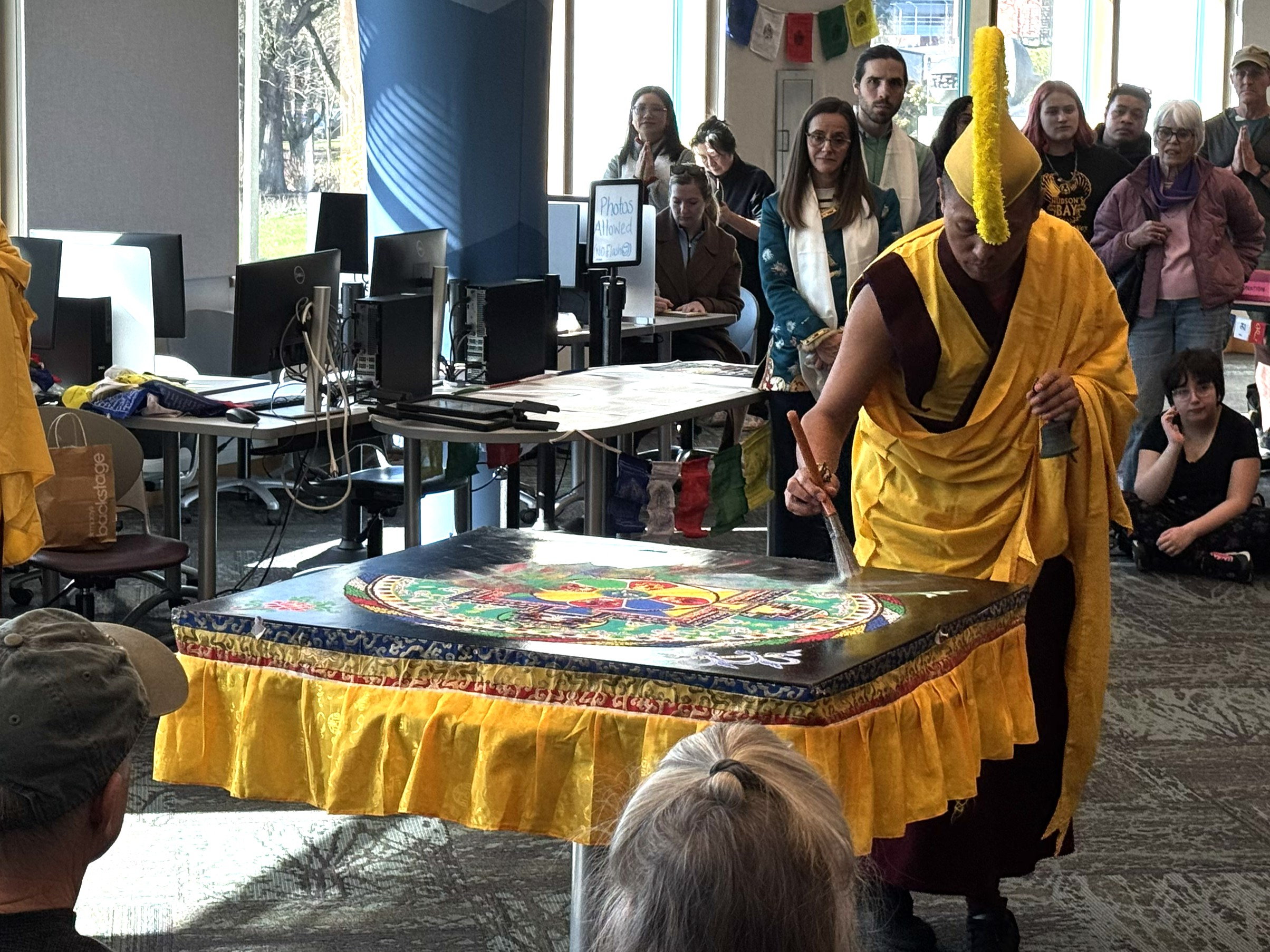 As with many things in life, the sand mandala was not meant to be a permanent fixture.
At the end of the week, the monks swept the carefully placed sand into a pile at the
center of the platform.
As with many things in life, the sand mandala was not meant to be a permanent fixture.
At the end of the week, the monks swept the carefully placed sand into a pile at the
center of the platform.
“The sand mandala reveals the truth of impermanence,” Dawa addressed the large crowd gathered at the closing ceremony. “We should learn to let go. We learn to accept change.”
While Dawa and Dhargyal chanted a mantra of compassion, they divided the sand into individual bags to be shared with members of the audience.
“Each grain of sand carries a prayer,” Dawa said. “May it bring peace and goodwill in your lives.”
After the closing ceremony, the remaining sand was dispersed in the Columbia River during a private ceremony.
International Day Celebrates Diversity
 On Thursday, Feb. 26, International Programs also hosted the 19th annual International
Day celebration for students.
On Thursday, Feb. 26, International Programs also hosted the 19th annual International
Day celebration for students.
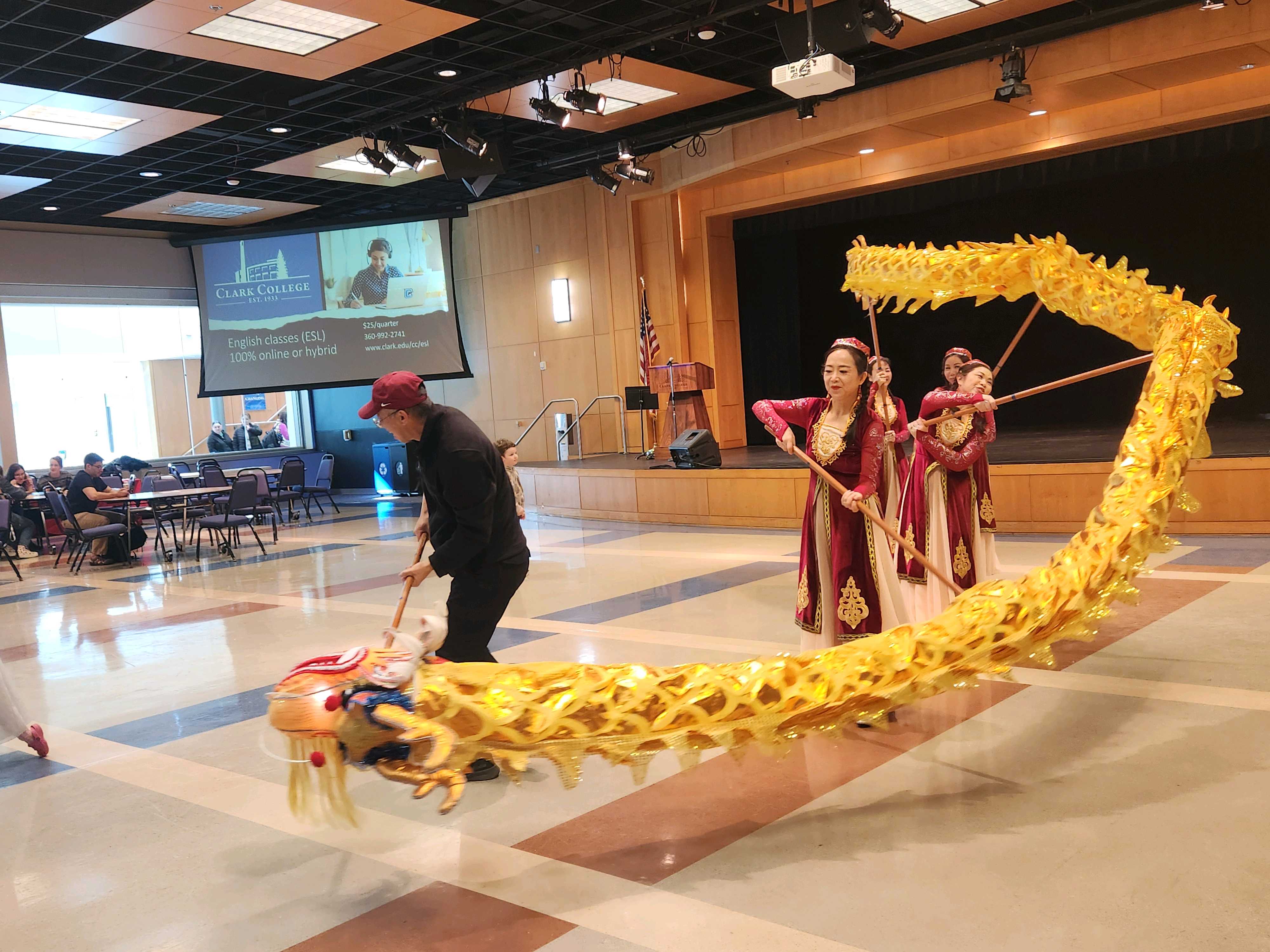
The Gaiser Student Center stage hosted a variety of musical acts, including a belly dance demonstration, a Ukrainian singer who also showed attendees the steps to a dance, the Clark College Choir, a Brazilian funk dance demonstration, and Chinese drummers, and a Chinese dragon dance (pictured right).
A henna tattoo artist had a line of students out the door waiting. Presenters also shared the cultural history of the Tibetan sand mandala. Attendees also got “passports” at the entrance and earned stamps at each vendor and culture club they visited. They could turn in completed passports for a chance at a door prize.
Students expressed appreciation for having a space where so many different cultures are represented in exhibits, entertainment, and food samples. Students were heard exclaiming, “I’ve never had Tibetan food before,” or “These Japanese chicken skewers are so delicious.”
Melina Doan, President of the Asian American Culture Club, said, “It’s great to see all these cultures here at Clark that are not normally represented.”
It’s not just the students who benefit. Chris Chaffin, Tutoring Program Support, said, “I come to this event every year and try to learn something new.” He also said, “The fact that we get to celebrate culture and cuisine… it really highlights what makes our different populations unique.”
Watch the Sand Mandala's Construction
Learn More About Clark's International Program
International Programs provides support services and opportunities to foster a global perspective and cross-cultural competence for Clark College and the communities it serves. The program also offers an intensive English Language program. During the 2025 fall term, Clark College hosted 78 international students. In 2026, international outbound programs include countries like Germany, Ireland, Costa Rica, Japan, Italy, and Portugal. Learn more about Clark’s International Programs.
Photos: Clark College/Maureen Chan-Hefflin, Malena Goerl, and Carly Rae Zent
Story by Malena Goerl, Staff Writer; and Carly Rae Zent, Digital Media Specialist, Communications and Marketing